Red Team Engagement
for Healthcare
Red Team Engagement for Healthcare by Security Researchers With 150+ CVEs in SAP, IBM, Microsoft, CyberArk and more...
Red Team Engagement That Tests Your Defenses
Most security programs follow this pattern:
Controls look good on paper.
Your SOC has detection rules.
Network segmentation between IT and OT is documented.
Everyone assumes the defenses work.
We show you what breaks, how it breaks, and what customer data is exposed
We simulate attackers who've breached your perimeter and test if they can access EHR systems, compromise medical devices, or exfiltrate PHI. You see which attack paths work and if your defenses stop them.
Why Healthcare Organizations Choose AFINE for Red Team Engagement
We've conducted red team operations on healthcare infrastructure in production for 10 years. You get operators who know how adversaries move from initial compromise to EHR systems and medical device networks, and reports showing exactly which controls failed.






Purple Team Mode Available
Most healthcare clients choose purple team collaboration during red team engagement. Your SOC sees our activity in real time. We explain what we're doing, what it looks like in logs, and how detection should work.
You get both security validation and immediate SOC improvements. Your analysts learn what sophisticated attacks look like while they're happening.
Our Services
What We Cover in Red Team Engagement for Healthcare
Electronic Health Record (EHR) System Access
We test lateral movement from internet-facing systems to EHR infrastructure during red team engagement. Clinical network segmentation effectiveness. Privilege escalation routes. Patient database access controls. We map attack paths from compromised workstations to Epic, Cerner, or Meditech systems and clinical data repositories.

Medical Device Networks and IoMT
We test attack paths to medical device networks and IoMT ecosystems. Infusion pump network access. Patient monitoring system exploitation. PACS workstation compromise. Testing wireless medical device security and whether your SOC detects unauthorized access to life-safety equipment before patient impact.
Patient Portals and Telehealth Platforms
We simulate account takeover and session hijacking attacks on patient-facing systems. API abuse bypassing authorization. PHI extraction through mobile health apps. Testing if fraud detection stops sophisticated attacks on patient authentication and telehealth session security.
Revenue Cycle and Administrative Systems
We test access paths to billing systems, insurance claim processing, and practice management platforms. Testing if compromising administrative systems leads to PHI access or provides pivot points to clinical networks.
SOC Detection and Response
We test if your SOC detects sophisticated attacks on healthcare infrastructure through red team engagement. Do SIEM rules fire on lateral movement to EHR systems? Does EDR catch credential dumping on clinical workstations? Purple team mode provides real-time feedback on detection capabilities for healthcare-specific threats.
Third-Party Integration Security
We assess Health Information Exchange connections, biomedical engineering vendor access, and cloud service provider integrations. Authorization across HL7 and FHIR interfaces. Whether compromise at one integration point provides access to clinical systems and whether monitoring covers third-party activity from HVAC contractors to IT support vendors.
Insider Threat Simulation
We test what happens when legitimate access gets abused - clinical staff credentials compromised, PHI exfiltrated from authorized systems, biomedical engineering access to medical devices. Testing if your monitoring catches insider threats that look like normal clinical workflow behavior.
AI/ML Security Testing
We test AI systems healthcare organizations deploy—prompt injection on clinical chatbots, clinical decision support system manipulation, diagnostic AI model poisoning. PHI extraction from model outputs. Testing if guardrails prevent unauthorized access to training data or manipulation of predictive analytics affecting patient care.
The Enterprise Security Software We Hacked
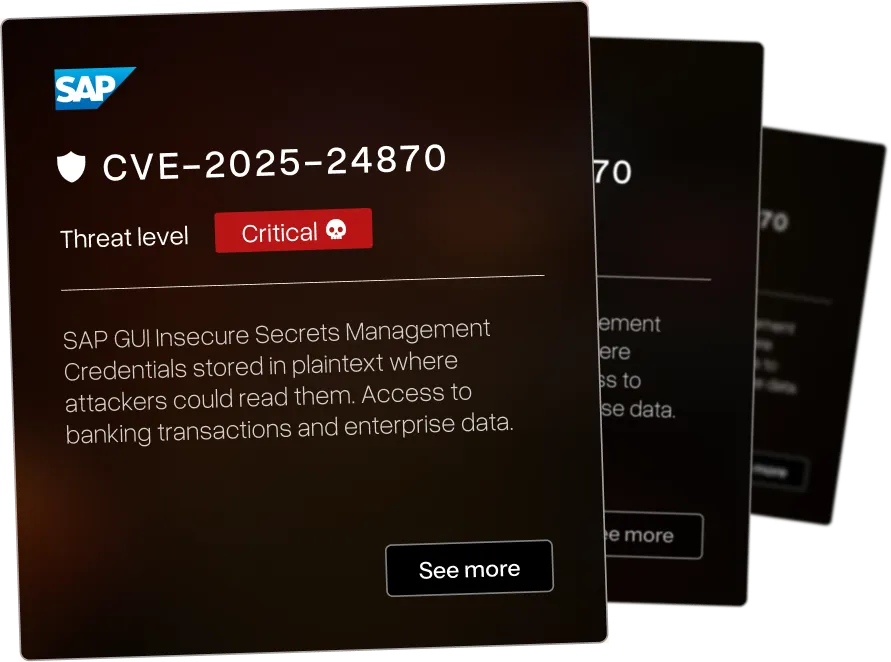
Our red team engagement operators discover vulnerabilities in the platforms healthcare organizations use We exploit both known CVEs and the vulnerabilities nobody's documented yet.


Memory corruption in Microsoft Edge (EdgeHTML) allows remote code execution via crafted web content



.webp)
Remote code execution via insecure deserialization in IBM i Access Client Solutions allows attackers to execute arbitrary code


Missing rate limiting on password change in CyberArk EPM allows brute-force attacks against user accounts
View All CVEs We've Published

.webp)

The AFINE Adaptive Security Framework (AASF)
A framework developed from a decade of security assessments and continuously refined as attack methods evolve. Our methodology reflects current threat patterns and the practical security decisions organizations face as their attack surface expands.
Fix-It Roadmap


Testing Built for Your Infrastructure


Dual-Track Reporting


Immediate Risk Intelligence


Fix-It Roadmap
Remediation prioritized by exploitability in your environment. You get CVSS scores and attack chain documentation showing what adversaries would target first in your payment infrastructure.
Tailored Red Team Engagement
Red team security testing methodology tailored to your cloud-native architecture, API landscape, and regulatory requirements.
Dual-Track Reporting
Security engineers receive exploitation details and proof-of-concept code. Leadership receives business impact analysis covering operational risk, safety exposure, and regulatory compliance.
Immediate Risk Intelligence
Authorized stakeholders receive confidential briefings on critical findings during red team security testing. You see what we've compromised and potential business impact as testing progresses.
Fix-It Roadmap
Priority-ranked remediation based on exploitability in your specific environment - not just CVSS scores in isolation. We give you specific implementation guidance so your teams know exactly what to fix, how to approach it, and why it matters for your setup.
Security Engagement Designed for Your Organization
We build our approach around your specific architecture, threat landscape, and how your business actually operates.
Dual-Track Reporting
Your technical teams get the full exploitation details and working proof-of-concepts they need. Leadership gets business impact: regulatory exposure, operational risk, revenue implications. No one's stuck playing translator.
Immediate Risk Intelligence
Critical findings come to you within 48 hours. We don't bury them in a final report you'll see weeks later. Your teams can start fixing immediately.
We’re ready to deliver next-level security
Why Organizations Trust Us
AFINE moved from third-choice pentesting supplier to first-choice partner. They keep finding important, and in a few cases even critical issues in places where other pentesters have not found them.

AFINE has been our security testing partner since 2020, consistently delivering exceptional results. Their team identifies advanced vulnerabilities that significantly strengthen our security posture. Reports clearly explain risks with actionable detail for rapid remediation. They consistently meet our aggressive deadlines while maintaining flexibility. Highly recommended as a trusted cybersecurity partner.
I am super impressed. This is really thorough. You have uncovered vulnerabilities that our previous pentest failed to detect. Incredible work. Thank you very much!
We've partnered with AFINE for over 5 years, during which they've conducted dozens of security audits for BGK - including penetration tests, security analyses, abuse testing, and source code reviews. Their work consistently meets the highest standards, delivers on time, and provides excellent value. I highly recommend AFINE for their professionalism, flexibility, and collaborative approach.
The AFINE team performed application analysis and tests of IT environments for us. Provision of services - at the highest level. Information received and knowledge transferred - priceless. I recommend it with a clear conscience, although you have to be prepared for strong impressions.
AFINE delivered sharply prioritized, high-impact findings that allowed us to focus our security efforts exactly where they mattered most. There was no wasted time on low-risk noise - only clear, actionable issues with real business relevance. The engagement was efficient, communication was excellent, and the return on investment was immediately evident.
Let's Discuss Your Security Posture
We scope every red team engagement based on your healthcare infrastructure and threat landscape. Book an assessment below to discuss your requirements.